It might come as a surprise that scrapbooks — mundane, somewhat old-school arrangements of photographs, newspaper clippings, greeting cards, and other ephemera — are worth archiving. But the Radcliffe Institute’s Schlesinger Library houses more than 600 of them among its collections.
Scrapbooks can help researchers fill in gaps of history with insights into the lives of ordinary people — sometimes people for whom there is little or no public record. This aspect of the collections is particularly important for the Schlesinger as the country’s leading center for women’s history, because so much of it was thinly documented in official sources.
“Scrapbooks are unique because there never is one singular formula,” says Victor Betts, curator for collections on ethnicity and migration at the library. “They’re a great way to introduce and tell people about hidden and unknown histories.”
Jenny Gotwals, the Johanna-Maria Fraenkel Curator for Gender and Society, said the collection has drawn significant interest among students and scholars doing research for projects, papers and dissertations.
Last spring, Betts co-taught “Asian American Women’s History in the Schlesinger Library,” an embedded course for which students worked with the library’s primary source materials.
Paired with the course was Schlesinger’s recent exhibition, “Illuminate: Contextualizing Asian American Women’s Stories through the Archives,” curated by Betts, which brought to light many marginalized histories.
The exhibition featured a display about the history of Japanese American incarceration, showcasing pages from scrapbooks, autograph books, and photo albums. Each item offers a close look into the lives depicted on the page, lived experiences that are too often forgotten.
“There is an autograph book from Crystal City, one of the camps in Texas, with sketches and signatures and messages from various people who were incarcerated in camps, in English, Japanese, of course, and then Spanish,” Betts said. “Why is there Spanish in this autograph book? There were actually Japanese Latin Americans whose governments, in cooperation with the U.S. government, shipped them to Crystal City; that’s a part of history not a lot of people know about.”
Rooted in the recordkeeping tradition of family Bibles and commonplace notebooks, scrapbooks have been around since the mid-19th century. Although the format has evolved somewhat over the centuries, few rules govern the contents of scrapbooks.
“The Schlesinger has traditionally called volumes that are just photos photo albums, and volumes that have multiple types of things scrapbooks,” explains Gotwals. But, “what can be in a scrapbook is anything.”
When considering scrapbooks for acquisition, Gotwals and her colleagues ask what can be learned from each item, what histories might be revealed or re-examined.
“Can we tell who made it? Are people [featured] named? Are there dates, titles, a menu from a restaurant? What is it that we can use to build a life story?”
Some scrapbooks and photo albums come to Schlesinger via donation as part of a larger collection, often from a notable source. Many others are one-offs, periodically from less well-known authors, purchased from rare book dealers who find them in thrift stores, estate sales — even dumpsters.
Sometimes, the most valuable insights gleaned from a collection involve what isn’t there.
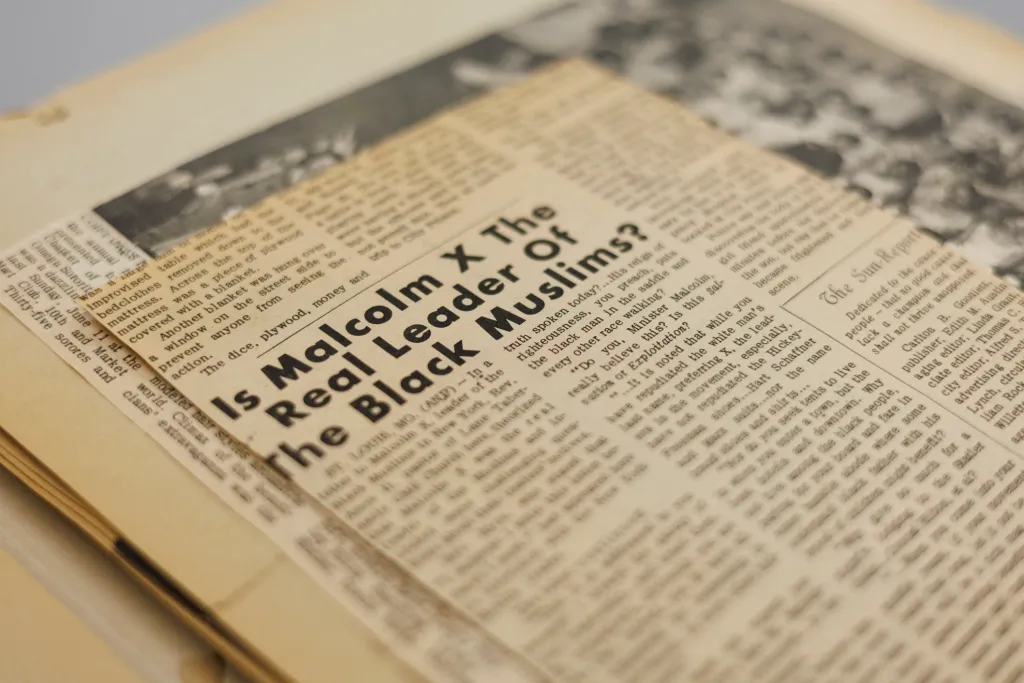
The scrapbook of Maggie Neyland Chatman, for example, is dedicated to social events like cotillion programming, debutante balls, weddings, and funerals that her family attended between 1940 and 1965. One clipping Chatman saved shows her daughter and two peers, primly dressed and smiling. On the flip side is part of an article, the headline fully visible in bold type: “Is Malcolm X The Real Leader Of The Black Muslims?”
Though the family, who lived in San Francisco, was African American, Chatman’s scrapbook reflects little interest in the Civil Rights Movement — or the Nation of Islam, for that matter (in fact, there were some Christmas cards in the collection). Yet the wider historical backdrop was there nonetheless.
“What’s interesting about an archive isn’t always about what the person does,” says Gotwals. Just as illuminating, if not more, is the narrative they attempt to create.
“What do we make in our life, and what can we learn from it?” Gotwals said. And for researchers: “How do we build knowledge out of these primary sources?”
Archivists like Jess Purkis, librarian/archivist for digital programs at the Schlesinger, give researchers broader access to primary sources through digitization. Each scrapbook brings new challenges: brittle paper, disintegrating newsprint, envelopes pasted to the page with letters still inside.